
What’s changed in marketing in 2025?
If you feel like the marketing world has been flipped on its head this year, you’re not wrong.
The 21st century has been one big step change after another in the marketing world, and the scale and speed of that change seems to accelerate with every passing year.
The fundamentals stay the same, but their application to new platforms and strategies is constantly updated and tweaked for changing audience behaviours and needs.
In this short article, we get into the weeds on what these changes are, what they mean, and what you can be doing to make the most of your marketing in 2026.
The good, the bad, and the sloppy
It won’t come as a surprise to anyone that one of the biggest disruptors is AI. Whether you think it’s a force for good or ill, Pandora’s box is well and truly open and there’s no shoving it back in. It’s everywhere and it’s changed the game forever.
Let’s start with the positives. AI is brilliant when it’s used for what it does best:
Automation
AI frees up time for the work that really matters by taking on menial administrative tasks.
Data crunching
It’s great at making sense of mountains of information or long, complex documents in seconds.
Helping you think
While it can’t churn out the finished article, it can help you gather your thoughts or structure an idea (like I did when pulling this blog together).
But it’s not all sunshine and rainbows. It isn’t a replacement for real marketers, copywriters, and designers. It’s a tool that’s there to make their lives easier and elevate their efficiency. Some people are yet to get the memo on this front. Overuse of AI is starting to show across socials and websites.
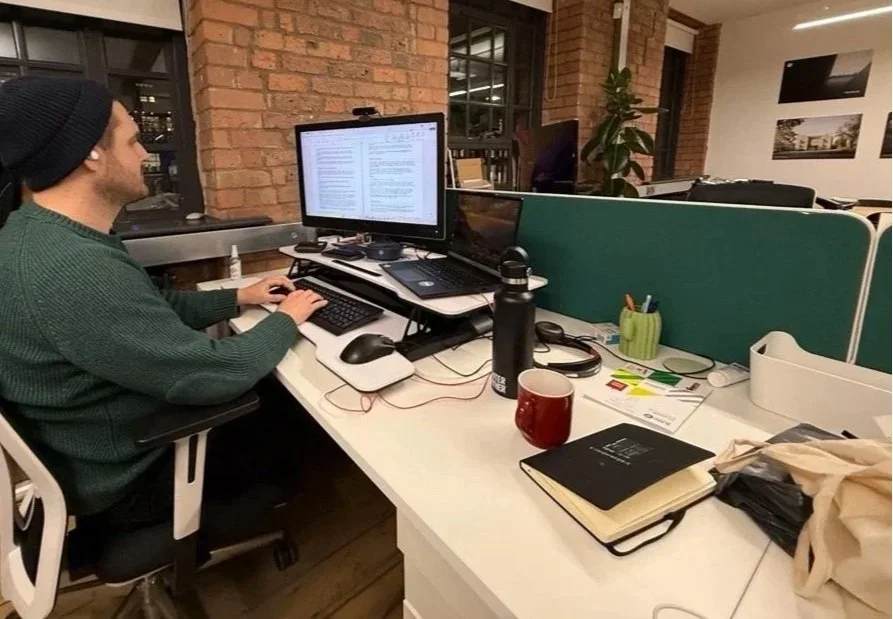
A human copywriter in his natural environment.
AI slop
Low-quality, generic content is flooding the internet. This is diminishing the variety and diversity of voices out there. What’s more, there’s a lot of content that lacks thought and has simply been plastered from an LLM straight into a website CMS. Who is this content really serving? The recursive nature of AI also means the information LLMs are absorbing now is itself AI-generated.
Creativity killer
When businesses use AI as a cheap replacement for human ideas, personality, and storytelling, their marketing, and their business, suffers.
And it doesn’t stop at marketing. AI is poking its nose into a lot of arenas, some it has no business in. AI as a tool in mental health care is a recipe for disaster. Do some research on chatbot psychosis and weep. Some things should never be automated.
Here’s the bottom line: AI is a tool, not a replacement for humans. Just like a paintbrush, a guitar, a chainsaw, or any other tool, it’s only ever as good as the person using it.
In a world of AI-generated slop, your marketing has to be exceptional to rise above. And it has to be human.
Search is changing
If you’re deep in the SEO weeds, you’ll have seen that AI is having a big impact on the way people are using search engines like Google. Not only are people using LLMs like ChatGPT as an alternative, Google’s own search results are now fronted by an AI-based synopsis.
There is opportunity amid the chaos here. With more and more people and businesses naively over-relying on AI, their content is getting lost in the noise. If you can demonstrate stylistically distinctive, human content that people genuinely find useful, you’ll stand a cut above the rest.
Brand
Clarity matters more than ever in this market.
In a noisy, AI-saturated world, brand is king. With so much low-effort work done on the cheap, a properly thought-out brand, with carefully distilled messages supported by research and a deep understanding of your market, acts as a clarion call to your target clients.
But you can’t half-arse it. You have to do the hard work so your vision, mission, and values punch through in plain, meaningful English. No more word soup. No more safe, boring, same-as-everyone visuals. Every brand touchpoint needs impact and needs to communicate the needs and desires of your market.
And don’t forget: sustainability, purpose, and culture aren’t optional anymore. They’re front and centre in buyer decision-making.
Personalisation:
There’s a lot of impersonal, cookie-cutter stuff out there. It’s scattergun, spray-and-pray marketing. What’s needed is calculated, carefully targeted sniper work.
When you really understand your client base, you can talk directly to them in the places you know you’ll find them. Two great ways of connecting away from search engines and chatbots are:
Email:
It’s still the most powerful weapon in your arsenal (it always was). But it takes effort to do it well, far more effort than a quick LinkedIn post.
Video:
This has to be real, not AI.
Whether short-form or long-form, video is where you prove you’re human. Show your face, your voice, your personality. Bring your brand to life and talk directly to your target market. When the message is right, you’ll resonate and get the right results.
Customer experience
Consistency can be a real killer in marketing, and that’s true now more than ever. Every touchpoint counts in your potential client’s journey.
This isn’t just about your website, although that’s certainly important. Every part of your presence, both online and in person, needs to sing your brand. The brand experience should be smooth, consistent, and communicative.
Attention spans are shorter than ever because of the bite-sized nature of the media we consume. Everyone has more to do and less time to do it. If you fail to make an impression in the short amount of time you’re given, you’ll potentially lose your lead.
That website cobbled together by your cousin? It won’t cut it. Broken widgets, outdated homepages, clunky menus. They signal you don’t care and send visitors straight to your competitors. That moribund LinkedIn page that sees sporadic activity every six months tells your audience you haven’t got anything interesting to say.
The built environment challenge
In property and construction, marketing has become trickier. Rising material costs, skills shortages, and regulatory backlogs have squeezed budgets. The national insurance increase this year hit marketing spend hard. Everyone has less to spend and needs marketing to work harder than ever.
With less to spend, you have to be more discerning with your activity. There’s no room for dead weight. Everything has to deliver results.
Here at Luma, we spent the summer building automations and an AI-powered dashboard to demonstrate marketing impact in real time across all platforms. This gives our clients the ability to hold us to account, see what’s working and what’s not, and ultimately frees up our people to do more creative work rather than juggling impact spreadsheets and reports.
Creativity isn’t optional anymore. It’s essential.

The bottom line
The waves of change will continue to ebb and flow with increasing frequency. Rather than being overwhelmed by them, you can take hope from the fact that, while the delivery shifts with each new iteration, the tried and tested foundations of good marketing remain the starting point.
Understand your audience
Build your brand around that understanding
Distil messages that resonate
Speak directly to your audience
Show how you can change their lives and their businesses
Monitor impact and change tack when things aren’t working.
AI isn’t going away. It’s here to stay and can be a potent tool in marketing. But it isn’t a substitute for creativity.
The brands that win in 2026 will feel personal, human, and real.
Creativity is, and always will be, essential.