
Has Manchester lost the plot, or have we just lost the story?
Have you seen the photo doing the rounds on socials? From the vantage point of the railway arch at Deansgate station, it shows the stark difference between the Manchester skyline in 2015 and 2025.
Manchester has changed beyond recognition over the past 10 to 15 years. That’s not a controversial statement. We’ve gone from being England’s second city (sorry Birmingham, it was never a serious competition) to a genuinely global one, attracting talent, capital and attention from well beyond the UK. We’re now the fastest-growing city-region economy in the UK.
So we should all be celebrating, right?
Not everyone agrees.
For a city that has benefited so visibly from development, there’s a growing sense from some that all is not rosy. Towers are seen as symbols of greed rather than homes. Investment is treated as extraction. Growth is talked about as something done to Manchester, not for it.
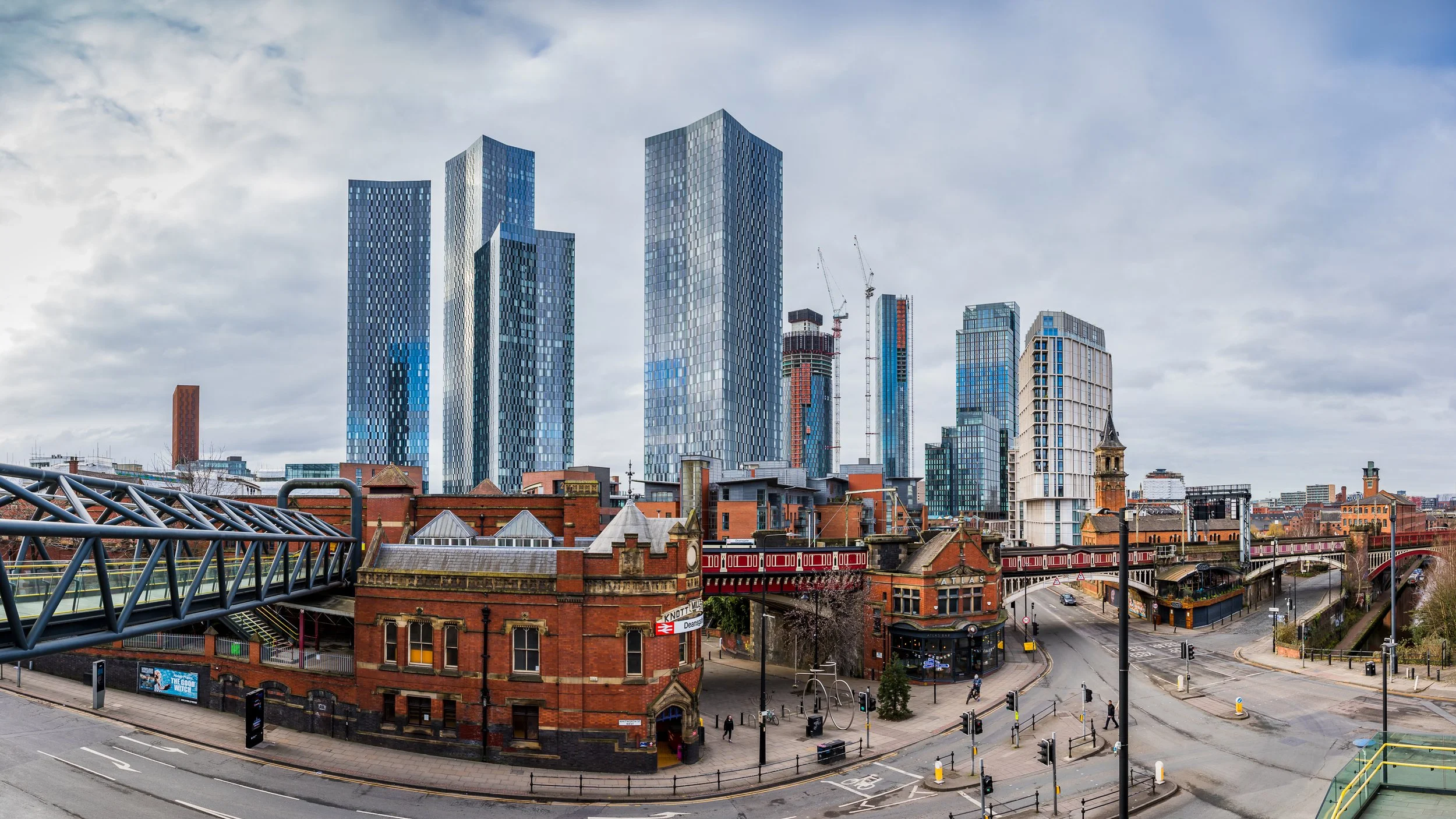
Some of that criticism is reasonable. Questions about affordability, who benefits, and how value is shared are legitimate and necessary. But alongside those debates sits a parallel narrative that is, quite simply, wrong. The idea that city centre Manchester is full of empty high-rise investment vehicles doesn’t stack up: vacancy rates are at historic lows. Foreign investment exists, yes, but most of those homes are occupied, largely by people who live and work here.
So how did we get here?
The short answer is that we lost control of the story.
Who’s telling the story?
The built environment has always been better at delivering places than explaining them. We rely heavily on data, policy, viability arguments and long-term benefits. We’re all in our little built environment microcosm where we all speak the same language. All important, all necessary, and all completely ineffective if the audience doesn’t trust the messenger.
Spreadsheets just don’t do much work when it comes to currying favour with the public. Public opinion is, and always has been, shaped by stories.
A perfect example sits outside Manchester but should worry everyone in the industry. The so-called 15-minute city.

At its heart, it’s a simple and broadly positive idea. Walkable neighbourhoods. Local services. Less time commuting and more time living. Healthier, less polluted places. Versions of this exist across continental Europe and are widely celebrated.
But in Oxford, and elsewhere, the concept was hijacked. What should have been a conversation about quality of life became one about control, surveillance, and restriction. Once tarred with an Orwellian brush, the accusations stuck and took on a life of their own.
This wasn’t a persuasive conspiracy theory either, it was just that it was emotional, human, and easy to grasp. Basically, it told a good story that people could relate to. Meanwhile, the industry response leaned on clarification documents and rational explanations. We lost the information battle before we realised we were in one.
Many of those schemes are now politically toxic. Not because they were bad ideas, but because they were badly explained.
Is Manchester facing the same problem?
The story being told about Manchester’s development is increasingly one of villains and victims. Machiavellian developers, distant investors and a city sold off piece by piece, all of which is a compelling narrative, even if the truth is much more complex and nuanced.
What’s missing is a competing story that feels equally human.
We talk about growth at a city scale. Critics talk about its impact at a personal one. You can make a reasonable guess about which resonates more.
If someone feels priced out, disconnected or unheard, it doesn’t matter how strong the macroeconomic case is. The tower becomes a symbol of everything that feels wrong, regardless of what’s actually happening inside it.
That’s not a planning problem. It’s a storytelling one.
What better storytelling actually looks like
Don’t mistake our meaning here. We’re not suggesting a full-scale campaign of spin or gloss. We just need to do the hard work of understanding the audience.
Good marketing in the built environment should start with a simple question. Who are we trying to convince, and what are they worried about?
From there, a few principles matter.
First, start with people, not buildings. Who lives in these homes? Who works nearby? Who benefits from the shops, services and transport that density makes viable?
Second, acknowledge fears rather than dismissing them. Concerns about affordability, ownership and identity don’t go away because we say they’re misplaced. We have to build trust by engaging honestly, not defensively.
Third, translate city-wide benefits into everyday ones. Shorter commutes. More jobs within reach. Streets that feel safer because they’re busier. Places that can support culture, not just survive it.
And finally, compete emotionally as well as rationally. If opponents are telling stories about loss of control, the response can’t be a planning statement. It has to be a story, in a local voice, about opportunity, pride, and belonging.
Marketing has to be built into the infrastructure
Manchester didn’t become successful by accident. But its future success depends on whether the people who live here feel part of the journey, not collateral damage from it.
If the built environment doesn’t get better at telling its own story, others will keep telling a very different one. And once a narrative sets and hardens, facts will always struggle to soften it.
Marketing and storytelling aren’t an afterthought to development or planning policy, they’re part of how cities function. Just like transport, housing, and public space.
We can keep building the city, but unless we also win hearts and minds, we shouldn’t be surprised when the skyline grows faster than public support.